
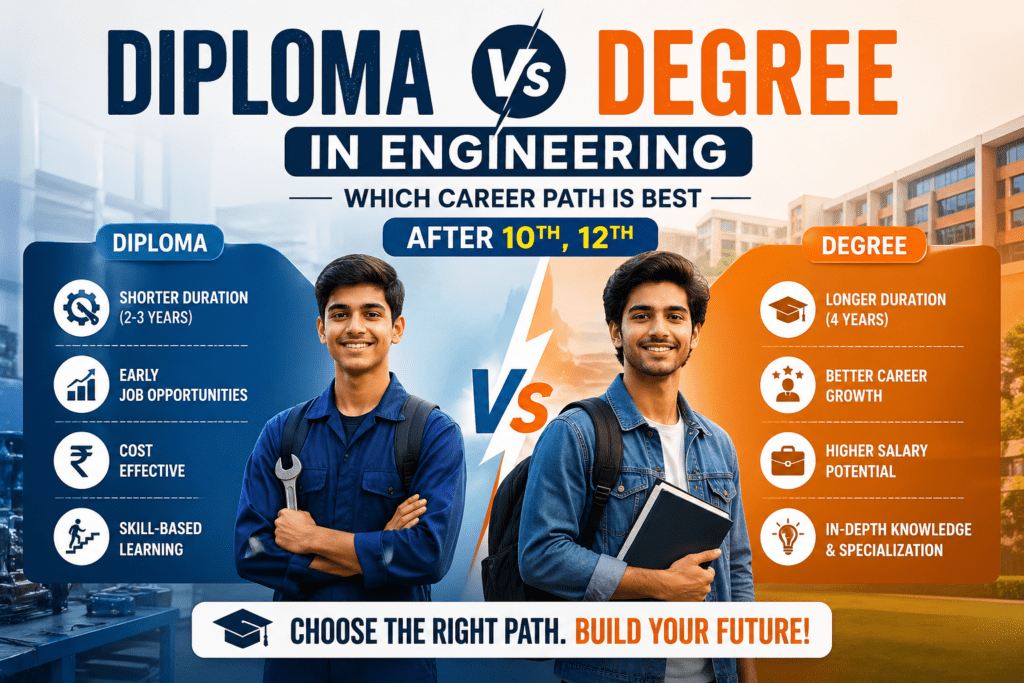
Choosing between a diploma and a degree in engineering is one of the most important career decisions after the Class 10 or 12 board exam results. Both paths can lead to successful careers—but they differ in duration, depth, cost, and long-term opportunities. This guide breaks down everything you need to make an informed, practical choice between the best career options: a Diploma and a Degree in Engineering.
What is a Diploma in Engineering?
A Diploma in Engineering is a 3-year vocational/technical program offered by polytechnic institutes across India. AICTE and the state boards of technical education regulate it. Students typically join after Class 10, though some states also allow admission after Class 12.
The curriculum is intensely practical and trade-focused — you learn by doing. There’s less theory and more hands-on work in the workshop, lab, and field. It’s specifically designed to produce skilled technicians who can contribute to industry from day one.
Key Highlights
- Duration: 3 years (after 10th) / 2 years (lateral entry after 12th ITI)
- Focus: Practical, skill-based learning
- Admission: Merit-based or polytechnic entrance exams
- Outcome: Junior-level technical roles or lateral entry to B.Tech
What is a Degree in Engineering?
A Bachelor of Technology (B.Tech) or Bachelor of Engineering (B.E.) is a 4-year undergraduate degree offered by universities and engineering colleges. It requires Class 12 with Physics, Chemistry, and Mathematics (PCM), typically with a JEE Main / state entrance exam score for admission to better colleges.
The curriculum balances theory with practice — you study the why behind things, not just the how. It includes higher-level mathematics, engineering sciences, electives, and project work. It’s the gateway to design roles, R&D, management positions, higher studies (M.Tech, MBA), and global opportunities.
Key Highlights
Outcome: Engineer roles, higher studies, research, and management careers
Duration: 4 years
Focus: Strong conceptual foundation + advanced technical training
Admission: National/state exams like JEE Main, JEE Advanced, or state CETs
Top Government Engineering Colleges In India
Diploma vs Degree in Engineering – Quick Comparison
| Criteria | Diploma in Engineering | Degree in Engineering (B.Tech/BE) |
| Eligibility | After 10th | After 12th (PCM) |
| Duration | 3 Years | 4 Years |
| Focus | Practical Skills | Theory + Practical |
| Cost | Lower | Higher |
| Career Start | Early (after diploma) | After graduation |
| Job Role | Technician / Junior Engineer | Engineer / Specialist |
| Higher Education | Limited (can do lateral entry) | M.Tech, MBA, Research |
| Salary (Starting) | ₹1.5–3 LPA | ₹3–8 LPA (varies widely) |
Which is better: a Diploma And Degree In Engineering
After 10th
If you’ve just passed Class 10, a Diploma in Engineering can be a smart move if:
- You want early entry into the workforce
- You prefer hands-on learning over theory
- You aim to save time and money
- You plan to later join B.Tech through lateral entry (2nd year)
Reality check: A diploma alone can limit long-term growth unless you upgrade your qualifications later.
After 12th
After Class 12 (PCM), a B.Tech/BE degree is generally the better choice if:
- You want higher-paying roles
- You aim for core engineering, R&D, or IT careers
- You’re targeting top institutions like the Indian Institutes of Technology or the National Institutes of Technology
- You plan for M.Tech, MBA, or government jobs
Bottom line: A degree offers better career flexibility and growth
How to Choose the Right Career Options After 12th Science
| Parameter | Diploma (Polytechnic) | B.Tech Degree |
| Who can apply? | Class 10 pass (or 12th in some states) | Class 12 pass with PCM |
| Duration | 3 years | 4 years |
| Government College Fees | ₹10,000 – ₹50,000 total | ₹50,000 – ₹2,00,000 total |
| Private College Fees | ₹50,000 – ₹1,50,000 total | ₹5,00,000 – ₹15,00,000 total |
| Focus of Study | Practical / Vocational | Theoretical + Practical |
| Entry-Level Salary | ₹1.5 – 3 LPA | ₹3 – 8 LPA |
| Top Tier Salary (IIT/NIT) | Not Applicable | ₹20 – 80+ LPA |
| Government Jobs (PSU) | ⚡ Limited Eligibility | ✔ Full Eligibility |
| R&D / Design Roles | ✗ Rare | ✔ Common |
| Start Working Early | ✔ Yes (at 19–20 yrs) | ✗ No (at 21–22 yrs) |
| Higher Education (M.Tech) | ⚡ Via B.Tech first | ✔ Direct Eligibility |
| Global Job Opportunities | ⚡ Limited | ✔ Strong |
| Lateral Entry to B.Tech | ✔ Yes (2nd Year) | N/A |
| Ideal For | Hands-on learners, tight budget, early earners | Long-term growth seekers, research interest |
Career Scope & Job Roles: Diploma And Engineering Degree
After a Diploma — Common Job Roles
Diploma engineers are especially valued in industries that need skilled hands at the supervisory and technical levels — manufacturing, construction, maintenance, utilities, and government infrastructure.
| Job Roles | Job Roles |
| Junior Engineer | Maintenance Technician |
| Site Supervisor | AutoCAD Draftsman |
| IT Support Technician | Production Operator |
| Quality Inspector | Machine Operator |
| Field Engineer (Telecom) | Electrical Supervisor |
Industries that heavily hire diploma engineers: L&T, TATA, Larsen & Toubro, BHEL, Indian Railways, State PWD departments, BSNL, local manufacturing companies, and construction firms.
After a B.Tech Degree — Common Job Roles
B.Tech graduates access a far wider range of roles, particularly in design, software, research, and leadership. The degree also opens doors to PSU exams (GATE), civil services (IES), and global opportunities.
| Job Roles | Job Roles |
| Software Developer | Design Engineer |
| Project Manager | Data Analyst / AI Engineer |
| Research Engineer | Product Manager |
| Civil / Structural Engineer | Quality Engineer |
| PSU Engineer (via GATE) | Entrepreneur / Founder |
Top recruiters for B.Tech graduates include: TCS, Infosys, Wipro, HCL, Google, Microsoft, Tata Motors, L&T, ONGC (via GATE), ISRO, DRDO, and hundreds of startups.
Pros & Cons: Diploma in Engineering
| Pros | Cons |
| Eligible after Class 10 — start earlier | Lower starting salary vs degree |
| Much lower fees (₹10k–1.5 lakh total) | Limited access to senior/design roles |
| Start earning by age 19–20 | Most PSU/government exams require degree |
| Strong hands-on and practical training | Not eligible for M.Tech directly |
| Lateral entry to B.Tech (2nd year) available | Less recognition globally |
| High demand in manufacturing & construction | Career ceiling can be hit early |
| Less academic pressure | IT sector roles largely closed without degree |
| Shorter path to employment |
B.Tech Degree– Pros And Cons
| Pros | Cons |
| Higher starting salary and career ceiling | Higher fees (₹5–15 lakh at private colleges) |
| Access to all engineering job roles | Requires JEE/entrance exam |
| Eligible for PSU, IES, UPSC exams | Requires JEE / entrance exam |
| Gateway to M.Tech, MBA, PhD | Quality varies hugely between colleges |
| Global recognition and opportunities | Many graduates from poor colleges struggle |
| R&D, design, and leadership roles | Heavy academic theory load |
| Wide choice of specializations | |
| Better placement infrastructure |
Top Private Engineering Colleges in India
Best Engineering Branches to Pick
The branch you pick matters — for both diploma and degree. Here’s a quick breakdown based on job market demand and salary trends:
| Branch | Good for Diploma? | Good for B.Tech? | Avg Salary (B.Tech Fresher) | Outlook 2026 |
| Computer Science (CSE) | ⚡ Moderate | ✔ Excellent | ₹6–14 LPA | 🔥 Highest demand |
| Mechanical Engineering | ✔ Strong | ✔ Good | ₹3–6 LPA | 📈 EV & Manufacturing boom |
| Civil Engineering | ✔ Strong | ✔ Good | ₹3–5 LPA | 🏗️ Infrastructure push |
| Electrical Engineering | ✔ Good | ✔ Good | ₹3–6 LPA | ⚡ Renewable energy growth |
| Electronics & Comm (ECE) | ⚡ Moderate | ✔ Excellent | ₹4–8 LPA | 📡 5G, IoT, Semiconductor |
| AI / Data Science | ✗ Not available | ✔ Excellent | ₹8–20 LPA | 🤖 Fastest growing |
| Chemical Engineering | ⚡ Limited | ✔ Good | ₹3–6 LPA | 🧪 Pharma & Petrochemical |
| Automobile Engineering | ✔ Good | ✔ Good | ₹3–5 LPA | 🚗 EV transition opportunity |
Which One Is Right For You? Diploma Vs Degree in Engineering
Use this framework — not peer pressure — to make your decision.
Choose Diploma (Polytechnic) If…
- You want to start working by age 19–20
- Your family needs financial support sooner
- You prefer learning by doing over sitting in lectures
- Your budget for education is limited
- You’re interested in manufacturing, construction, or maintenance roles
- You want to explore engineering before committing 4 years
- You plan to upgrade via lateral entry B.Tech later
- JEE preparation is not something you want to pursue after 12th
Choose B.Tech Degree If…
- You have PCM after 12th and can invest 4 years
- You aspire to software, AI, R&D, or design roles
- You want to appear for GATE, IES, or PSU exams
- You’re interested in higher studies (M.Tech, MBA, PhD)
- You want to work with MNCs, startups, or globally
- You have clear interest in a specific technical domain
- Long-term career growth and salary ceiling matter most
- You have the academic aptitude and study discipline
Conclusion
The choice between an engineering diploma and an engineering degree is a tough nut to crack that will decide your career path in the engineering field. Both types of study have their features and positions and can satisfy different career aspirations. It doesn’t matter whether you decide to obtain a specialized engineering diploma or a full engineering degree at a well-known institution; this is the next logical step to ensure that you are free from problems in the future job market in the field of Diploma or Engineering.
Frequently Asked Questions
After 10th, the natural choice is Diploma (B.Tech isn’t available directly after 10th, only after 12th PCM). A Diploma is a solid path — 3 years, practical training, affordable fees, and early employment. Later you can upgrade to B.Tech via lateral entry. There’s no wrong answer here; it depends on your goals.
Absolutely yes. Diploma holders work as Junior Engineers, Technicians, Site Supervisors, and even independent contractors. Many Diploma holders who upgrade via lateral entry B.Tech rise to Senior Engineer and managerial positions. The “diploma is not engineering” stigma is outdated and industry-specific.
At entry level: Diploma engineers typically earn ₹1.5–3 LPA, while B.Tech freshers earn ₹3–8 LPA on average (higher from premium institutes). However, with experience and if a diploma holder upgrades their qualification, the gap narrows significantly in core engineering sectors. In IT and software, the gap remains wider.
Yes, but with limitations. Diploma holders can apply for certain Junior Engineer posts in government departments and some PSUs. However, GATE-based PSU jobs, IES, and most central government engineering posts require a B.Tech or B.E. degree. For state government junior engineer posts, diploma eligibility varies by state.
If you’ve already completed 12th with PCM, a B.Tech degree is almost always the better choice. You’ve already cleared the prerequisite, and entering a polytechnic diploma after 12th is largely redundant — you’d be taking a step backward in academic standing. The only exception is if your 12th score is very low and you want to enter the workforce quickly in a hands-on role.
Based on job market data for 2026, the best branches for diploma holders are: Mechanical Engineering (manufacturing, EV industry), Civil Engineering (infrastructure projects), Electrical Engineering (renewable energy, utilities), and Automobile Engineering (EV transition). Computer Science diplomas are also useful but the software sector strongly prefers B.Tech graduates.